Sign in



What are FCC, CE and RoHS on Network Cards
< BackOn product labels or manuals of fiber network cards, marks such as FCC, CE and RoHS can often be seen. These certification marks prove product compliance and reflect the product quality in electromagnetic compatibility, safety and environmental protection. This article briefly explains these common certifications and their practical value for users.
FCC Certification: EMC Threshold for the US Market FCC stands for Federal Communications Commission of the United States. FCC certification controls electromagnetic interference (EMI) and radio frequency radiation of electronic products. A network card with FCC certification means its electromagnetic radiation during operation stays within specified limits and will not interfere with other devices; meanwhile, it has certain anti-interference capability. For users, FCC certification is an important reference for product electromagnetic compatibility. Certified network cards are less likely to have communication anomalies caused by electromagnetic interference in complex computer room environments.
CE Certification: Passport to Enter the European Market The CE mark is a mandatory safety certification of the European Union, covering the Low Voltage Directive, EMC Directive and other requirements. CE certification requires products to meet EU standards in electromagnetic compatibility, health protection and safe usage. Network cards with CE certification indicate their design and production meet the access requirements for the European market. From the user perspective, CE certification represents the overall level of electrical safety and electromagnetic compatibility. Though not a performance metric, it serves as a reference to evaluate overall product quality.
RoHS Certification: Guarantee of Environmental Protection & Health RoHS refers to the Directive on the Restriction of the Use of Certain Hazardous Substances in Electrical and Electronic Equipment. It restricts the content of hazardous substances including lead, mercury, cadmium, hexavalent chromium, PBB and PBDE in electronic products. RoHS certification confirms that components and soldering materials of the network card contain no excessive hazardous substances. For users, RoHS certification means the product will not pollute the environment during use or disposal, and reduces potential health risks of hazardous substances to operators. Nowadays RoHS has become an environmental standard adopted by major global markets.
Relationship Between Certifications and Product Quality It should be clarified that certifications focus mainly on compliance rather than performance indicators. Passing certifications does not guarantee outstanding NIC performance, but uncertified products may have risks of electromagnetic interference, safety hazards or environmental issues. Formal manufacturers will actively complete mandatory certifications for target markets, which shows responsibility to customers. All fiber network card series from Guangruntong (GRT) Technology have passed international authoritative certifications including FCC, CE and RoHS. Our products can be circulated compliantly worldwide and deliver safe, eco-friendly usage guarantees. As a China-based global communication enterprise, Guangruntong (GRT) always prioritizes product quality and user safety.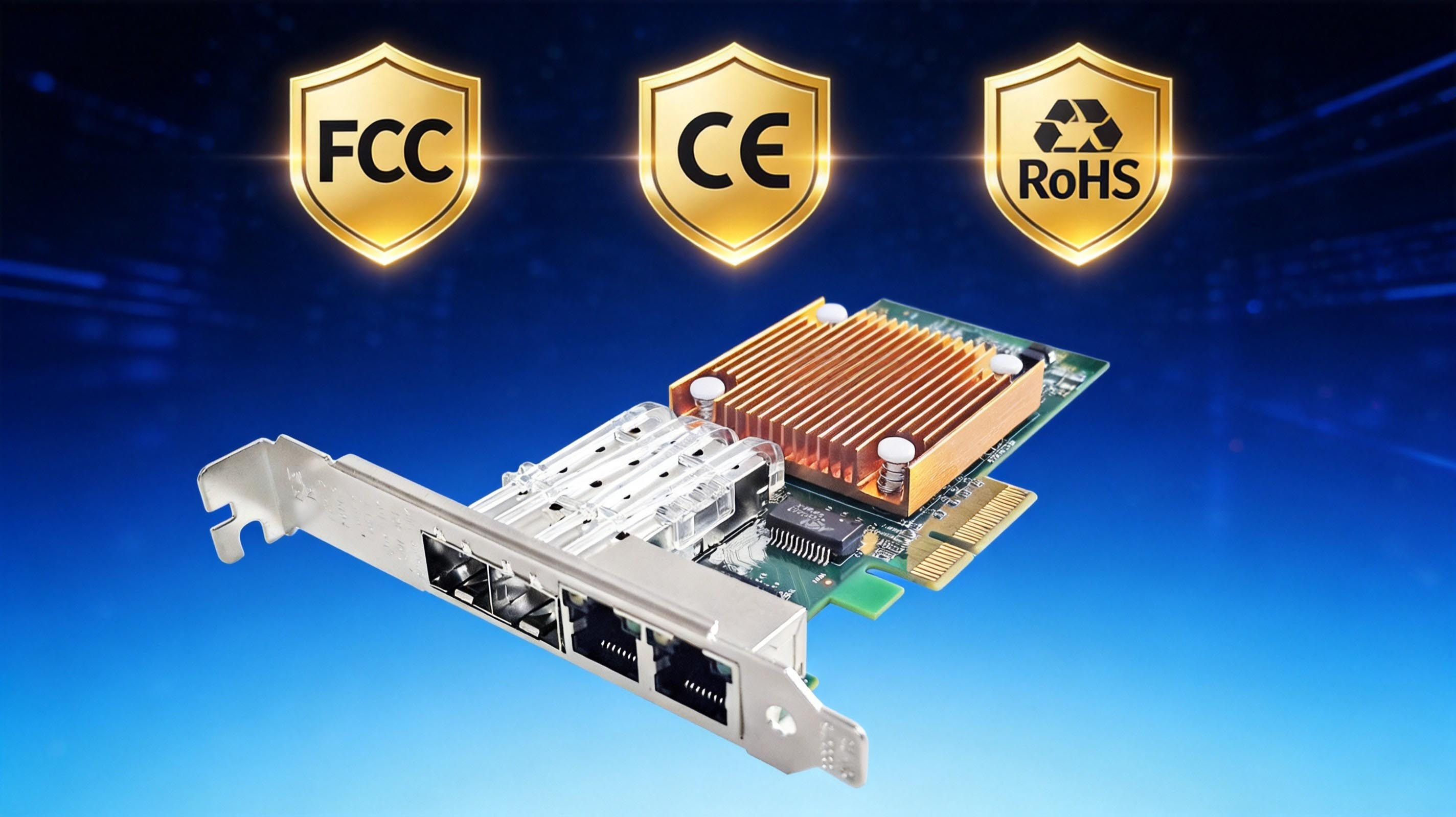
- Prev: How Bypass NIC Ensures Uninterrupted Network When Server Power Fails
- Next: None
Latest information
- What are FCC, CE and RoHS on Network Cards
- How Bypass NIC Ensures Uninterrupted Network When Server Power Fails
- The Key Role of Bypass Network Cards in Firewalls
- Choosing Between Fiber NIC and Copper NIC: Application Scenarios Determine Interfaces
- Ambassador Chang Hua of the People’s Republic of China to Saudi Arabia Visits GRT Booth at LEAP 2026
- Server NIC Selection: Why Is OCP 3.0 Becoming the New Standard for Data Centers?
- Fantastic start on the first day of LEAP 2026!
- Overlooked Physical‑Layer Issues in Fiber NIC Deployment